
On our arrival in Mayapur on the 30th of November we immediately dived into the preparations for the Holy Name Retreat at Ekachakra - our annual event of bliss and immersion into chanting the holy name - a program which over the years has become very dear to my heart.
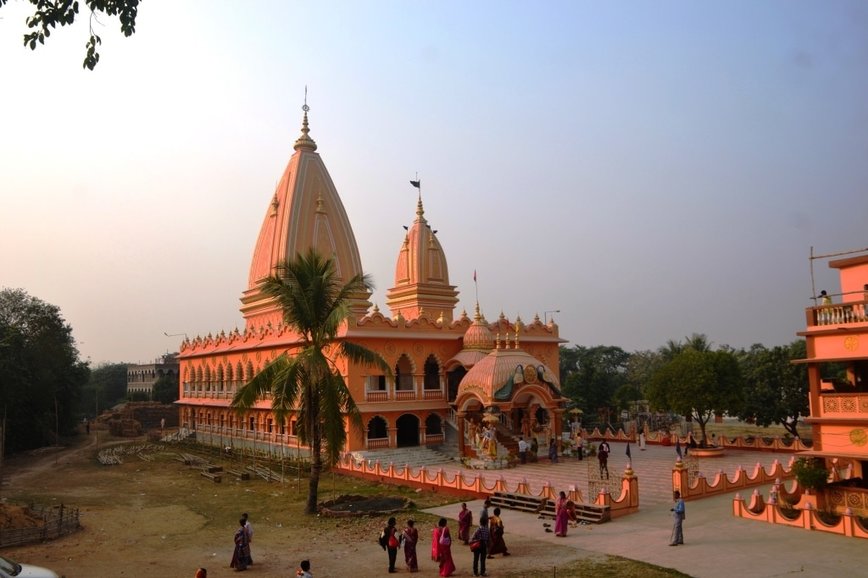
We had a big group of 53 participants from every corner of the globe: North America, different parts of Europe, South America, Australia, Russia, Ukraine - and of course India. Every bed on the premises of the ISKCON temple at Ekachakra was booked. HH Candramauli Maharaja also joined our group and participated in the retreat, enlightening us in the morning classes in connection with the holy name. The mood was once again so wonderful - sweet and deep.
Especially those participants who agreed to switch off their phones and computers for the entire retreat could enter a different reality - the holy name alone being everything....
We had a big group of 53 participants from every corner of the globe: North America, different parts of Europe, South America, Australia, Russia, Ukraine - and of course India. Every bed on the premises of the ISKCON temple at Ekachakra was booked. HH Candramauli Maharaja also joined our group and participated in the retreat, enlightening us in the morning classes in connection with the holy name. The mood was once again so wonderful - sweet and deep.
Especially those participants who agreed to switch off their phones and computers for the entire retreat could enter a different reality - the holy name alone being everything....
 |  |

Spending four days together in seclusion and endeavoring to receive deeper
insights into the secrets of chanting the holy name had a very uniting effect on the hearts of our participants and created a very confidential and intimate atmosphere. Even though we may not have known each and every person's names - nevertheless, the holy name set a special foundation to our relationships and united us on deeper levels of eternal reality: our relationship to Krishna through chanting His holy name.
During these retreats, the evening kirtans are always especially sweet. After going through the internal work of spending all day in hearing and discussing various aspects of chanting - when applying the same principles in the evening kirtans, we could indeed experience a different quality of kirtan, which I have only ever experienced in these retreats!
Many participants described the retreat as eye-opening, as they not only learned new techniques but also gained a deeper understanding of the spiritual essence of chanting. The setting at Ekachakra provided an ideal environment for this transformation, allowing participants to step away from the distractions of daily life and focus entirely on their relationship with the Holy Name.
We have all heard the analogy that Srila Prabhupada gives us in regards to chanting the holy name: We should cry out to Krishna like a helpless child calling out in desperation for his mother. It is a simple yet profound analogy. A child crying in helplessness does not have the problem of a wandering mind. The child will not say: “Whenever I cry for my mother, my mind is thinking of so many things: where to play, whom to play with, what to play...!” No, there is no room in a child’s mind for any other thought except, “Where is my mother? I need her right now!”
This is what it means to cry out in helplessness and desperation. We can therefore understand that simply engaging in a boxing match with the mind will not bring us to deeper levels of chanting; instead the holy name will remain on the level of our mind and intelligence. We have to bring Krishna’s holy name to the level of the heart.
If our heart is actually involved when crying out to Krishna, then our mind will be drawn to the heart and will not be distracted any longer. Our problem is that we don’t feel desperate for Krishna. We have ignored and neglected Him for so many lifetimes! We continue thinking that we can be happy without Krishna being part of our life. Therefore, we are lacking the feeling of helplessness and desperation. We also lack the humility to feel truly helpless. Our pride gives us the confidence that we are fine without Krishna, thinking we have everything perfectly under control. As people in Australia commonly exclaim, “No worries, mate”! With a ‘no-worries-mate’ attitude to life we will not feel helpless enough to call out to the Lord.
Srila Prabhupada explains the importance of feeling helpless in his purport to the Srimad-Bhagavatam (1.8.26):
"Actually the Lord’s holy name has such powerful potency. But there is a quality to such utterances also. It depends on the quality of feeling. A helpless man can feelingly utter the holy name of the Lord, whereas a man who utters the same holy name in great material satisfaction cannot be so sincere. A materially puffed up person may utter the holy name of the Lord occasionally, but he is incapable of uttering the name in quality. Therefore, the four principles of material advancement, namely (1) high parentage, (2) good wealth, (3) high education and (4) attractive beauty, are, so to speak, disqualifications for progress on the path of spiritual advancement."
insights into the secrets of chanting the holy name had a very uniting effect on the hearts of our participants and created a very confidential and intimate atmosphere. Even though we may not have known each and every person's names - nevertheless, the holy name set a special foundation to our relationships and united us on deeper levels of eternal reality: our relationship to Krishna through chanting His holy name.
During these retreats, the evening kirtans are always especially sweet. After going through the internal work of spending all day in hearing and discussing various aspects of chanting - when applying the same principles in the evening kirtans, we could indeed experience a different quality of kirtan, which I have only ever experienced in these retreats!
Many participants described the retreat as eye-opening, as they not only learned new techniques but also gained a deeper understanding of the spiritual essence of chanting. The setting at Ekachakra provided an ideal environment for this transformation, allowing participants to step away from the distractions of daily life and focus entirely on their relationship with the Holy Name.
We have all heard the analogy that Srila Prabhupada gives us in regards to chanting the holy name: We should cry out to Krishna like a helpless child calling out in desperation for his mother. It is a simple yet profound analogy. A child crying in helplessness does not have the problem of a wandering mind. The child will not say: “Whenever I cry for my mother, my mind is thinking of so many things: where to play, whom to play with, what to play...!” No, there is no room in a child’s mind for any other thought except, “Where is my mother? I need her right now!”
This is what it means to cry out in helplessness and desperation. We can therefore understand that simply engaging in a boxing match with the mind will not bring us to deeper levels of chanting; instead the holy name will remain on the level of our mind and intelligence. We have to bring Krishna’s holy name to the level of the heart.
If our heart is actually involved when crying out to Krishna, then our mind will be drawn to the heart and will not be distracted any longer. Our problem is that we don’t feel desperate for Krishna. We have ignored and neglected Him for so many lifetimes! We continue thinking that we can be happy without Krishna being part of our life. Therefore, we are lacking the feeling of helplessness and desperation. We also lack the humility to feel truly helpless. Our pride gives us the confidence that we are fine without Krishna, thinking we have everything perfectly under control. As people in Australia commonly exclaim, “No worries, mate”! With a ‘no-worries-mate’ attitude to life we will not feel helpless enough to call out to the Lord.
Srila Prabhupada explains the importance of feeling helpless in his purport to the Srimad-Bhagavatam (1.8.26):
"Actually the Lord’s holy name has such powerful potency. But there is a quality to such utterances also. It depends on the quality of feeling. A helpless man can feelingly utter the holy name of the Lord, whereas a man who utters the same holy name in great material satisfaction cannot be so sincere. A materially puffed up person may utter the holy name of the Lord occasionally, but he is incapable of uttering the name in quality. Therefore, the four principles of material advancement, namely (1) high parentage, (2) good wealth, (3) high education and (4) attractive beauty, are, so to speak, disqualifications for progress on the path of spiritual advancement."
 |  |
Srila Prabhupada points out the danger of material satisfaction, which may invite pride, complacency and lethargy into our heart. Material satisfaction is based on material opulence, which can easily lead to pride and arrogance. In such a state of mind, one cannot call out to Krishna in helplessness. Material satisfaction is diametrically opposite to the feeling of helpless desperation.
His Holiness Gour Govinda Maharaja describes an ISKCON temple as a crying school, where we learn how to cry out to Krishna. This nicely sums up the very essence of devotional life: to cultivate helpless dependence on the Lord and His devotees.
In a lecture on the Bhagavad-gita (8.21–22.) on 19 November 1966, in New York, Srila Prabhupada explains:
"This meaning of Hare Krishna is ... It is just addressing the Supreme Lord and His energy, Hara. Hara is the energy, and Krishna is the Supreme Lord. So we are addressing, Hare Krishna, Hare Krishna: ‘O the energy of the Lord, O the Lord, please accept me.’ That’s all. ‘Please accept me.’ We have no other prayer. ‘Please accept me.’ Lord Chaitanya taught that we should simply cry, and we shall simply pray for accepting us. That’s all. So this vibration is simply a cry for addressing the Supreme Lord, requesting Him, ‘Please accept me. Please accept me.’"
To be accepted by Krishna is not a cheap thing. Who do we think we are to be accepted by Him? Our heart has to be flooded with an intense longing and begging for the position of being accepted and welcomed by the Lord. This mood within our hearts should not only be there in japa, but also in kirtan. We may sometimes hear so many esoteric meanings of the maha-mantra, but the very essence of it is, “I need help...!” Unless we clearly come to this understanding and chant the holy name with this quality of feeling in our heart, our chanting will not become heart-deep.
To be attentive on the level of the heart requires deep internal work. We have to become personal in our relationship with Krishna, consciously directing ourselves towards Him while calling out in helplessness: “I know You are there – please accept me!”
The secret is to chant while mindfully turning towards Krishna, appealing to Him with a deep and genuine longing in our heart – longing for this loving relationship. Only such chanting that is filled with longing, will develop our relationship with Him.
Only when we chant with such a quality of feeling within our heart will our relationship with Krishna develop and gradually become a tangible reality in our daily life. Such a desperate appeal towards the Lord can only be expressed if we are in a humble state of mind. Therefore, Mahaprabhu has instructed us to be more humble than a blade of grass and more tolerant than a tree.
Chanting without being mindful of Krishna’s presence can be compared to an empty medicine capsule. There’s no medicine inside, and thus no effect! It is only external lip service. From outside it may seem like the real thing, but it is simply a shadow or semblance of the holy name. Then our chanting may become a dry, mechanical duty and will not reawaken our loving relationship with the Lord......
Your servant, Devaki dd
Please visit www.theholynameretreat.net
www.therootsofspiritualculture.net
https://www.facebook.com/instituteforspiritualculture/
His Holiness Gour Govinda Maharaja describes an ISKCON temple as a crying school, where we learn how to cry out to Krishna. This nicely sums up the very essence of devotional life: to cultivate helpless dependence on the Lord and His devotees.
In a lecture on the Bhagavad-gita (8.21–22.) on 19 November 1966, in New York, Srila Prabhupada explains:
"This meaning of Hare Krishna is ... It is just addressing the Supreme Lord and His energy, Hara. Hara is the energy, and Krishna is the Supreme Lord. So we are addressing, Hare Krishna, Hare Krishna: ‘O the energy of the Lord, O the Lord, please accept me.’ That’s all. ‘Please accept me.’ We have no other prayer. ‘Please accept me.’ Lord Chaitanya taught that we should simply cry, and we shall simply pray for accepting us. That’s all. So this vibration is simply a cry for addressing the Supreme Lord, requesting Him, ‘Please accept me. Please accept me.’"
To be accepted by Krishna is not a cheap thing. Who do we think we are to be accepted by Him? Our heart has to be flooded with an intense longing and begging for the position of being accepted and welcomed by the Lord. This mood within our hearts should not only be there in japa, but also in kirtan. We may sometimes hear so many esoteric meanings of the maha-mantra, but the very essence of it is, “I need help...!” Unless we clearly come to this understanding and chant the holy name with this quality of feeling in our heart, our chanting will not become heart-deep.
To be attentive on the level of the heart requires deep internal work. We have to become personal in our relationship with Krishna, consciously directing ourselves towards Him while calling out in helplessness: “I know You are there – please accept me!”
The secret is to chant while mindfully turning towards Krishna, appealing to Him with a deep and genuine longing in our heart – longing for this loving relationship. Only such chanting that is filled with longing, will develop our relationship with Him.
Only when we chant with such a quality of feeling within our heart will our relationship with Krishna develop and gradually become a tangible reality in our daily life. Such a desperate appeal towards the Lord can only be expressed if we are in a humble state of mind. Therefore, Mahaprabhu has instructed us to be more humble than a blade of grass and more tolerant than a tree.
Chanting without being mindful of Krishna’s presence can be compared to an empty medicine capsule. There’s no medicine inside, and thus no effect! It is only external lip service. From outside it may seem like the real thing, but it is simply a shadow or semblance of the holy name. Then our chanting may become a dry, mechanical duty and will not reawaken our loving relationship with the Lord......
Your servant, Devaki dd
Please visit www.theholynameretreat.net
www.therootsofspiritualculture.net
https://www.facebook.com/instituteforspiritualculture/
 RSS Feed