
After spending 10 days in Cologne offering programs and getting ready to embark on my tour around the US, I arrived at my first destination - the temple in Philadelphia.
It was my first visit to this community. I had met Mahapremavesa Prabhu in Mayapur who took part in most of my courses. And he very efficiently coordinated my visit and assisted me in many ways. The temple facilities are great – two big buildings connected through a temple room building, which were formerly a hotel. There are plenty of rooms which are rented out to devotees and favourable people, and several rooms are also being used on Sundays for children’s programs for various ages. Since the TP is in a Western body, it attracts also some Western people, so the congregation is not only from Indian descent.
The heart of the temple community finds its center in their beautiful temple Deities: Their Lordships Sri-Sri Radha-Saradbihari, Lord Jagannatha, Lord Balarama, and Srimati Subhadra-devi, and Sri Sri Gaura-Nitai.
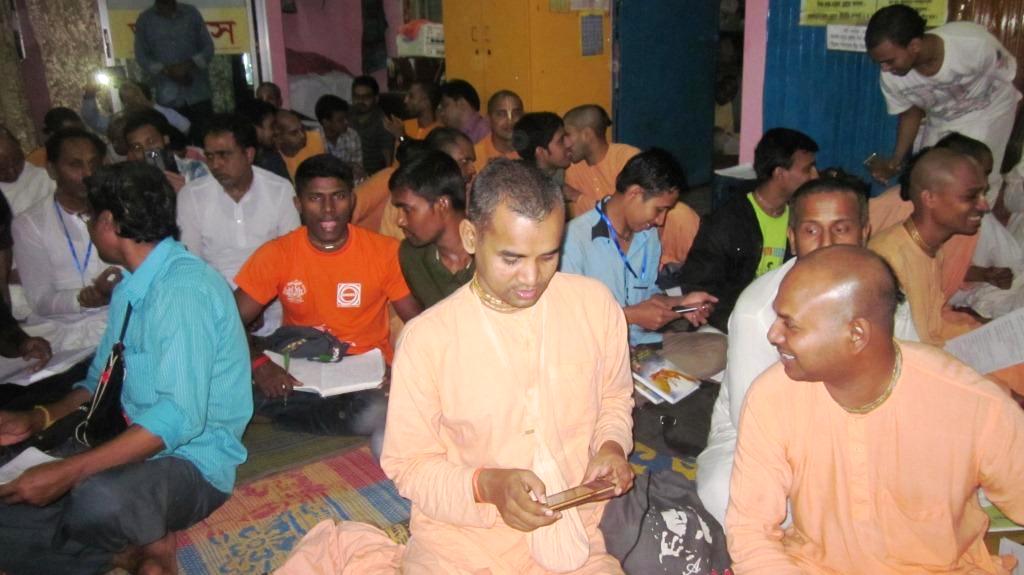
The devotees had arranged a variety of programs which were very well attended and received, and we blissfully churned thoughts and realisations while enjoying each other's association.
It was my first visit to this community. I had met Mahapremavesa Prabhu in Mayapur who took part in most of my courses. And he very efficiently coordinated my visit and assisted me in many ways. The temple facilities are great – two big buildings connected through a temple room building, which were formerly a hotel. There are plenty of rooms which are rented out to devotees and favourable people, and several rooms are also being used on Sundays for children’s programs for various ages. Since the TP is in a Western body, it attracts also some Western people, so the congregation is not only from Indian descent.
The heart of the temple community finds its center in their beautiful temple Deities: Their Lordships Sri-Sri Radha-Saradbihari, Lord Jagannatha, Lord Balarama, and Srimati Subhadra-devi, and Sri Sri Gaura-Nitai.
The devotees had arranged a variety of programs which were very well attended and received, and we blissfully churned thoughts and realisations while enjoying each other's association.
 | |

We can understand tolerance to be a secondary manifestation of humility: A humble person will be tolerant, and also patient, forgiving, compassionate, and so on. A proud and arrogant person, on the other hand, will be driven by his false ego and will not be able to exhibit such exalted qualities. Humility and tolerance are natural qualities of the pure soul not affected by false ego – they constitute the ‘humble-servant consciousness’, which is diametrically opposite to the ‘false-ego consciousness’.
Tolerance is a most important quality within spiritual practice. It is the main criterion used to measure a devotee’s advancement and spiritual strength. What agitates and disturbs us are the demands of the false ego for a certain satisfaction. As the false ego is more and more dissolved, we can be more and more tolerant.
In the purport to the Srimad-Bhagavatam (11.19.36–39), we find a wonderful description of tolerance:
"Tolerance means to patiently endure unhappiness, such as that provoked by the insults or negligence of others. One must also sometimes accept material inconvenience to carry out the injunctions of scriptures, and that unhappiness must also be patiently endured."
To be insulted or neglected is a most painful provocation to our false ego. It challenges us and ignites the desire for revenge and retaliation, prompting us to defend. Unless we have cultivated the quality of tolerance, it will be impossible to resist the temptation to defend. The strong pushings of our false ego will not allow us to control our speech and not answer back, trying to have the last word. We will not be able to patiently endure the pain and unhappiness inflicted by such attacks on our false ego.
Tolerance means that even in the most provocative situation of being attacked, insulted, neglected or defamed, we will not be agitated or defensive. We simply let it pass by.
In material life tolerance is not given any credit at all. In fact, it is seen as a weakness, and a tolerant person falls into the category of being a ‘loser.’ A materialist considers a tolerant person as being too weak to defend themselves. Very often we hear people say, “I’m not going to tolerate this. Who do you think I am?” and “How long should I tolerate this nonsense?” It is considered to be a sign of strength and victory not to tolerate. However, within spiritual life the values are diametrically opposite.
In this way, to a materialist, the glories of tolerance are very foreign, if not entirely unknown. What is victory for the spiritualist is considered a defeat for the materialist. What is the greatest success for a materialist – to always vehemently defend himself – is regarded as being a failure in the eyes of a spiritualist (BG 2.69)
Needless to say, the importance of tolerance does not in any way justify abuse. This cannot be stressed enough. Abusive behaviour has to be dealt with - also, to protect the person committing the abuse from receiving heavy reactions for their offensive behaviour.
Sometimes we hear people say, “How much can we tolerate? When I try to tolerate, so much negativity builds up inside me. All these bad emotions only increase my negativity, until I get sick or explode! How can this be purifying?”
In the above experience, we suppress the demands of our false ego and try to swallow the pain we feel when being insulted or neglected. We stuff a lot of emotion down inside and bottle it up, almost as if sealing it with a cork. But inside of us, the false ego continues to rebel and protest. We continue the ego battle within – the fight and demand for justice. We maintain the attitude of being unfairly treated, and so on. We are not doing the internal work of dissolving the ego but rather suppressing it, until the cork pops and all the bottled-up emotions come pouring out in an explosion.
This cannot be called cultivating tolerance. True tolerance means that we take shelter of Krishna by connecting our situation with His divine arrangement. We ask ourselves 'What is He trying to teach me? There must be a reason why He is putting me in this situation.' A Vaishnava’s attitude is ‘Krishna is so merciful! He has kindly protected me from so much more suffering which I am destined to encounter.’
Only with such a humble attitude and unflinching faith in Krishna can we cultivate true tolerance.
On the 25th of March I flew on to Dallas....
Your servant, Devaki dd
Please visit www.theholynameretreat.net
www.therootsofspiritualculture.net
https://www.facebook.com/instituteforspiritualculture/
Tolerance is a most important quality within spiritual practice. It is the main criterion used to measure a devotee’s advancement and spiritual strength. What agitates and disturbs us are the demands of the false ego for a certain satisfaction. As the false ego is more and more dissolved, we can be more and more tolerant.
In the purport to the Srimad-Bhagavatam (11.19.36–39), we find a wonderful description of tolerance:
"Tolerance means to patiently endure unhappiness, such as that provoked by the insults or negligence of others. One must also sometimes accept material inconvenience to carry out the injunctions of scriptures, and that unhappiness must also be patiently endured."
To be insulted or neglected is a most painful provocation to our false ego. It challenges us and ignites the desire for revenge and retaliation, prompting us to defend. Unless we have cultivated the quality of tolerance, it will be impossible to resist the temptation to defend. The strong pushings of our false ego will not allow us to control our speech and not answer back, trying to have the last word. We will not be able to patiently endure the pain and unhappiness inflicted by such attacks on our false ego.
Tolerance means that even in the most provocative situation of being attacked, insulted, neglected or defamed, we will not be agitated or defensive. We simply let it pass by.
In material life tolerance is not given any credit at all. In fact, it is seen as a weakness, and a tolerant person falls into the category of being a ‘loser.’ A materialist considers a tolerant person as being too weak to defend themselves. Very often we hear people say, “I’m not going to tolerate this. Who do you think I am?” and “How long should I tolerate this nonsense?” It is considered to be a sign of strength and victory not to tolerate. However, within spiritual life the values are diametrically opposite.
In this way, to a materialist, the glories of tolerance are very foreign, if not entirely unknown. What is victory for the spiritualist is considered a defeat for the materialist. What is the greatest success for a materialist – to always vehemently defend himself – is regarded as being a failure in the eyes of a spiritualist (BG 2.69)
Needless to say, the importance of tolerance does not in any way justify abuse. This cannot be stressed enough. Abusive behaviour has to be dealt with - also, to protect the person committing the abuse from receiving heavy reactions for their offensive behaviour.
Sometimes we hear people say, “How much can we tolerate? When I try to tolerate, so much negativity builds up inside me. All these bad emotions only increase my negativity, until I get sick or explode! How can this be purifying?”
In the above experience, we suppress the demands of our false ego and try to swallow the pain we feel when being insulted or neglected. We stuff a lot of emotion down inside and bottle it up, almost as if sealing it with a cork. But inside of us, the false ego continues to rebel and protest. We continue the ego battle within – the fight and demand for justice. We maintain the attitude of being unfairly treated, and so on. We are not doing the internal work of dissolving the ego but rather suppressing it, until the cork pops and all the bottled-up emotions come pouring out in an explosion.
This cannot be called cultivating tolerance. True tolerance means that we take shelter of Krishna by connecting our situation with His divine arrangement. We ask ourselves 'What is He trying to teach me? There must be a reason why He is putting me in this situation.' A Vaishnava’s attitude is ‘Krishna is so merciful! He has kindly protected me from so much more suffering which I am destined to encounter.’
Only with such a humble attitude and unflinching faith in Krishna can we cultivate true tolerance.
On the 25th of March I flew on to Dallas....
Your servant, Devaki dd
Please visit www.theholynameretreat.net
www.therootsofspiritualculture.net
https://www.facebook.com/instituteforspiritualculture/
 RSS Feed